Monday, August 12, 2013

easy tea


Mint can be a very invasive plant, crowding out other more desirable plants.
Instead of fighting a losing battle to try to get rid of the stuff, give up and turn lemons into lemonade, or more correctly, turn invasive leaves into tea.
There's a colony of spearmint in my rock garden that needs some discipline, and some applemint by the house that is looking far too healthy.  So yesterday, I got busy.
spearmint
apple mint

I picked the leaves, set them on cookie sheets lined with foil, and put them in the oven at 120 degrees for 20 minutes.  The leaves made the houses smell wonderful as they were drying.
mint leaves ready for the oven


below:  the leaves are ready for tea. 


a purple lawn


This time of year, many lawns on PEI turn purple.  Wild creeping thyme, a low-growing plant, blooms and colours lawns with waves of purple.
When I worked at the sales counter at Vesey's Seeds, this plant was a controversial issue.  Locals would come in with an offending piece of it and declare their absolute disgust - they wanted to know about ways to get rid of it.  Tourists would come in and ask about the lovely shimmer of purple on people's lawns and ask how they could have some of that on their own properties.
Wild creeping thyme is very hard to get rid of.  It is not affected by pesticides, and hand-pulling is impossible, because the stems break off and the roots remain in the soil and re-grow.
On the other hand, it is hard to purposely establish it in a lawn.  Just throwing the seeds on your lawn probably won't work.  You would have to clear a space, scatter the seeds, and water until they germinate and become established.
I would tell people who are trying to get rid of it to relax and accept the things they cannot change.  Bees love the nectar - and the plants support much more life than a desert of manicured green grass ever will.


Monday, July 29, 2013

raspberry

When we left on holidays ten days ago, my raspberries were green, hard things that looked like they would never ripen.  But when we got back, perfect berries awaited us.  From three 20-foot rows, I picked about ten cups of fruit, and I'll continue picking every two days for at least two weeks.

This is what happens when you plant raspberry plants in rows just three feet apart.  This is a solid thicket that takes courage to wade through.  I get scratched by the thorny branches, and end up breaking brittle branches.  Back in the spring, the plants looked lost and lonely and very sparse, and there seemed to be too much room between rows.   The lesson:  plant raspberries in rows at least 6 feet apart.  It won't seem to make sense when you are planting the scrawny little canes, but this picture proves where they can go.

Yesterday I went on a garden tour.  I saw three magnificent properties that made me feel like a pretender in the garden.  The lesson I came away with is:  go big or go home.  Make big beds, and use big ornamental grasses and big shrubs and big perennials.  The effect is like being in a jungle hideaway.

As I walked through and observed the meticulous edging, the complete lack of weeds, and the amazing lay-outs and garden designs, I suddenly became super aware of the long way my own garden needs to go before reaching anywhere near that state of perfection.  Even the vegetable gardens were neat, with plenty of open space between the rows, nothing like my tangled veg garden, where I let volunteer pumpkin vines and poppies run riot.

In one immaculate garden, I came upon an out-of-the-way spot with a row of raspberries.  But what sorry things they were!  Dead canes, few leaves, but still bravely putting out a few berries.  At last I had found one area which could use a bit of help.  Here are some tips for revitalizing a tired raspberry patch:

  • In late fall, after the leaves have fallen from the canes, cut to the ground any canes that are brown and flakey.  These are the ones that bore fruit this past year, and they will not produce again.
  • The green canes:  if they are more than six feet tall, give them a trim.  These canes will produce fruit next year.
  • Support:  Install posts every six feet, and string a line at 2 feet and another line at 4 feet.  Tie branches to the lines.
  • Pull out as many weeds as possible. 
  • Put down a thick layer of well-rotted manure around each plant, and mulch with pine needles or straw.
  • In spring, do another check, trimming any branches that seem out of place, and stand back.  In late July, you will be rewarded with a great crop of raspberries!


Monday, July 8, 2013

the challenge of wild strawberries


To me, running a marathon or slaying a dragon is not nearly as big a challenge as this:  picking wild strawberries.  Within a short walk behind my house is a weedy patch of wild strawberries protected by mosquitoes and horseflies just waiting for a fool like me to wander by.  Each berry is smaller than a pea, and grows a mere inch or less from the ground.
After staggering home with half a bucket full, my job isn't done.  Then I need to handle each tiny nugget again as I take off the hull and pack in into a freezer container.

8 wild strawberries fit into this teaspoon.

So why have I spent over an hour in each of the last four days tramping through the weeds, swatting madly, my bent back screaming for relief?  Because the amazing flavour of these berries has precious little to do with those monster berries we can buy any time of the year in the grocery store.  And because I can't stand the thought of them going to waste.  Nothing else seems interested in eating them, except for tiny slugs.
I started wondering why they are here - what ecological niche are they filling?  Why do they produce fruit at all, since they reproduce by producing a new plant at the end of a long runner?
Some things are unknowable.  But in the mean time, I will give these babies a function, a reason to be.

Tuesday, June 25, 2013

lovely leaves


Flowers are usually the main attraction where plants are concerned, but leaves are really even more important.  You can count on flowers to provide the razzle dazzle for a few weeks at most, but leaves are there for the whole season, and they add their own charm.


With this geranium, the orange flowers are not even noticed.
It's all about those leaves in white, maroon, red, and green.

The feathery texture of these ostrich ferns are a great contrast with  the more solid  hosta

Variagated with silver, this lamium is stunning even without the purple flowers


.
I nursed this Blackie sweet potato vine through the winter, and it is a  great addition to a planter.

Leaves from the purple smoke bush are a great contrast with the creeping Jenny and the wild strawberries.
This rose is old - I brought it with me from Ontario 18 years ago.  It always seemed healthy until this year.  The leaves look sickly, like something is sucking out their insides.
But within a few days, this plant was covered with pink flowers, so I guess it's ok.


Wednesday, June 19, 2013

a rainbow of irises

Bearded irises are in their glory in my garden at the moment.  Check out this rainbow of colours!
Each flower lasts only a day or two, but a lower bud is waiting in the wings, ready to dazzle us all over again.
How many other brown flowers are there?  This beauty proves that brown isn't dull..

Two-tone purple, with velvety falls and a yellow beard

I bought this one last year.  It was already in bloom, which forced me to get it.
This is an older cultivar, more transparent and not as vibrant, but still lovely
this one has leaves striped with cream and it smells like lemons


This is a Dutch iris, which grows from a small bulb planted in the fall.
a beautiful dark blue, dusted with white

Tuesday, June 11, 2013

before and after

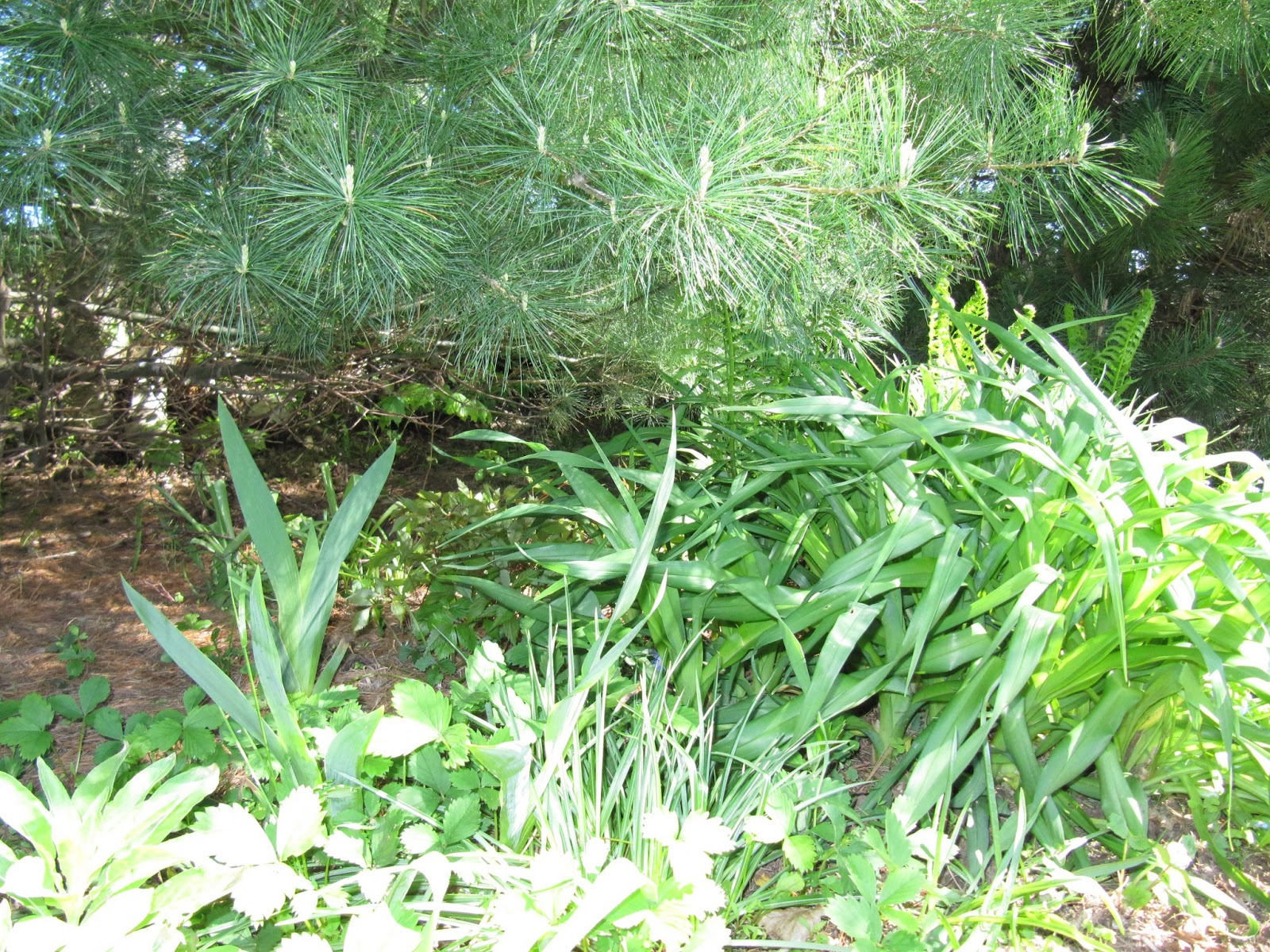
It all started out when I noticed that the tiny white pines I dug out of the back woods a few years ago are now about 15 feet tall and casting a shadow on all the plants that once looked so good around them.  I had no room to put these poor light-starved plants in a better spot, so I started digging to make more flower bed space.  Here's the before:
Here's the trapped plants:  iris, day lily, and other sun lovers that stopped blooming:
As I did the back-breaking labour of taking off the sod and wheeling it away, I found buried treasure.  An arrow, shot at least 10 years ago by my son Dylan, had been covered like archeological ruins.

After days of digging out the sod and shaping the curves, I had an expanded bed with lots of space, which was quickly filled by transplants from my other bursting at the seams beds.
I'm pretty happy with the result.  Who wants all that grass anyways?