Wednesday, August 19, 2015

bugs in the blooms

Not sure what this guy is - maybe a cicada or a fat grasshopper?

Many people shudder when the insect world comes in contact with their world.  But most insects don't do any damage to the garden.  They are an indication that all is well in your environment - that pesticides which can kill them all are not doing unseen damage to other creatures.  Insect adults, larvae, and eggs also provide an important food source for birds, amphibians, and reptiles who depend on them to survive.

Hers is a look at what is crawling and flying around my garden:
Green iridescent bug (perhaps a hover fly) on a daylily.
Honeybee in the butterfly weed


This longhorn beetle came too close to my environment.
I found him on the livingroom rug.

I talk a good game about being friendly with the insects in my world, but now I'm eating my words.
A steady stream of bees is buzzing in and out of a spot under the step just a foot from my front door.
I want to be a good steward of the environment, but I also don't want to get stung.

Haven't decided if I'm going to bring out the big pesticide guns, or if I will just choose to use the side door for the rest of the summer.

This moth was hitchhiking on the side of my car.

Friday, August 7, 2015

darling day lilies

Lots of plants have common names that don't really indentify them correctly.  For example, Rose of Sharon is not a rose.  Lily of the Valley is not from the lily family.  And neither are day lilies.  They are called Hemerocalis. They are actually quite different.  Lilies have bulbs, and day lilies have roots.  Lilies have leaves along their stems, and day lilies have bare stems and separate long leaves.

Day lilies are also (I hope that by writing this, a new and destructive insect does not suddenly finds my garden) not bothered by insects or disease, while my poor Asiatic and Oriental lilies are chewed mercilously by Scarlet Lily Beetle adults and larvae.


Sunday, August 2, 2015

a visit to South Korea

In July, we visited our son, who teaches English in South Korea.  The weather was hot and humid, and we enjoyed the overcast days and the rain, and I loved the flowers and trees and the unique aestetic of Korean architecture both old and new.

A garden on the grounds of the National Museum of Korea
is a cool oasis in a hazy city of skyscrapers.


The site of the 1988 Seoul Olympics has beautiful gardens 
ringed with the flags of the world. The purple flower is phlox.
Olympic park has huge pieces of art framed by hedges
Another piece of art at Olympic Park - foot bones
The national flower of South Korea is the Rose of Sharon (mugunghwa in Korean),
 which blooms across the country from July to October.  
This small tree is very hardy and is not bothered by disease or insects.

Other varieties of rose of sharon include doubles in pink and white,
and my favourite, white with with a red eye.

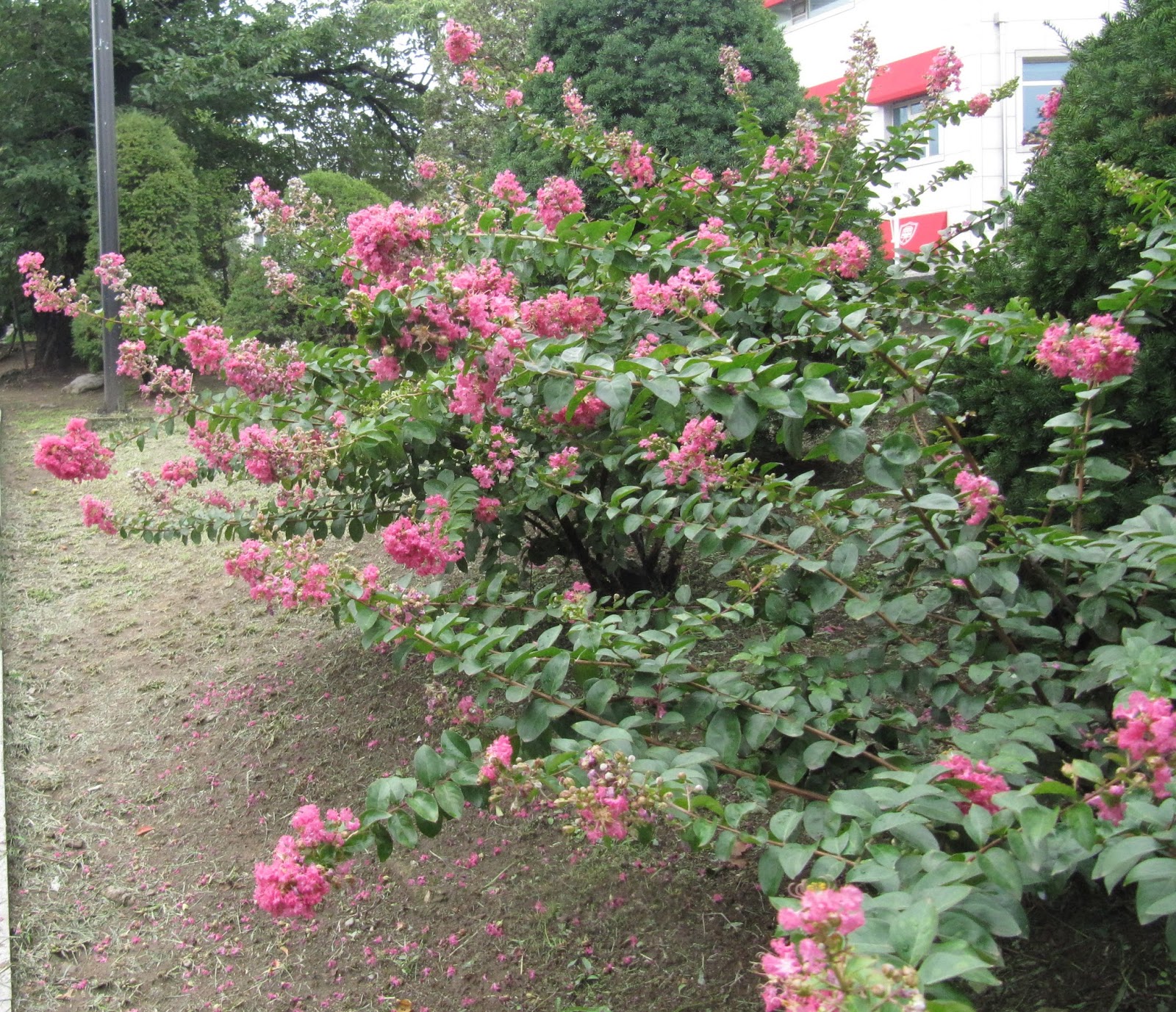
Crape Myrtle (Lagerstroemia indica) grows everywhere.

Korea has been experiencing drought this summer.
Many trees have been fitted with bags of water that slowly irrigate them.

I thought this was a toad lily - but I'm not sure.  The leaves look like a small iris, and it forms big seedheads after the flower fades.
Loud raucous screeches of the Korean magpie, or "kkachi" in Korean 
are drowned out by the sawing of cicadas high in the trees.
The rose garden at Olympic Park has many varieites of floribunda and tea roses.
framing our son Dylan in the roses
The roses were beginning to fade in the summer heat, 
but the display of varieties was stunning.


The rear garden of Changdeok Palace in Seoul. 

An egret posed at the edge of the lotus pond at the rear garden.
glorious tiger lilies
The beautiful colours and patterns of the underside of this pavilion 
is a motif found in traditional structures all over Korea.

Thursday, July 9, 2015

blooms from York to Scotchfort

My bike just had a tune-up, and I decided to test it out.  So I rode the 2 km to the Confederation Trail, and cycled on and on through fields and woods.  I saw robins, red-winged blackbirds, gold finches, and I heard many more.  And the wild flowers are in full force.
Within 6 weeks, these white blackberry flowers will morph into lucious fruit on prickly stems 
that will make me work hard to pick every berry.
Bunchberry flowers will produce fiery orange berries that are not edible to us humans.
These big balls of fluff look like giant dandelions.
The forest opens to reveal a bog of blueberries and other plants.
In the bog is another type of fuzzy seed head held high above grassy leaves.
 A fragrant wild rose along the path.
Blue flag iris in the bog.
A huge variety of ferns grow in the shade of trees along the trail.  
This is cinnamon fern (note brown fronds),
This fern seems to like more sun.
Delicate feathery ferns lead to a resting spot along the trail.  
Now if only the mosquitoes would lay off when I get off my bike!

This looks like a type of wild azalea. 


Grayish-white lichen carpets a small section along the trail.  
I've never seen this plant anywhere else.
2 km from my house is where I get to the trail, where I start at km 183.  This is near km 200, a beautiful way to end the trip, with a view of the Hillsborough River.  Now all I have to do is cycle back 20 km.  Oh - my poor legs, and my poorer seat!  This is going to hurt for a while.
 On the exhausting way back, I stopped to pick a few wild strawberries, and a tiny bright butterfly landed on my thumb.  As I looked at it closely, it seemed to be sucking up the salty sweat on my finger.  It stayed on my finger for a long time, and I struggled to take pictures of it with one hand. When the mosquitoes became impossible to bear, I finally gently shook it off, and it flew right back and landed on my thumb again.
I finally convinced my friend to check out the wild strawberries.
During my 4 hours on a sunny perfect day, I met only one other person using this trail.
We Islanders don't know how lucky we are here on PEI to enjoythis beautiful, free way to enjoy nature.  I hope more people get out and discover the beauty all around us.

Saturday, July 4, 2015

peony power

Peonies bloom for such a short time - three weeks max. And they attract ants.  and the double ones need to be staked or they will droop to the ground with the first rain weighing down the big heavy blooms.  But they sure are beautiful.  And they smell wonderful.

I discovered the perfect peony for me - single flowers.  They are very hard to find - almost no one sells these.  But the flowers have just one layer of petals, are light as a feather, and don't need to be staked.  So I think they are great.


Thesse beauties have delicate petals, are full of bees, so they are great addition to the natural landscape.  Just one thing - they have no fragrance, which is a bit disappointing.
Here is a lovely pink single called "Dancing Butterflies"

A gardening friend started 72 peonies from seed.  Seven years later, she has a long row of single-flowering peonies, and has now decided she doesn't like them as well as the doubles.  So she offered me as many as I could carry away.  This is not the ideal time to transplant peonies (the rule is to transplant before or after blooming, not during) but she wanted rid of them, so I just appreciated the gift. I stacked the big plants in the passenger seat, the trunk and the back seat of the car.  It looked like I was taking the flowers for a ride!  After finding a home for each in my flower beds, I cut off all the flowers.  It's hard enough for a plant to become established after being moved without supporting flowers as well.  Most definitely the plants will suffer a set-back, and probably won't bloom for the next few years, but it will be a lovely surprize when they finally do.