Tuesday, October 27, 2020

bluejay with a problem


Bluejays are very common around here, and they enthusiastically go after the sunflower seeds and especially the peanuts we feed them.  

I noticed one bluejay tilting his head and looking very uncomfortable as he struggled to pick up a peanut.  Looking closer, I saw that he had no top beak!  Yikes!  How can he even feed himself?  He looks just as plump and healthy as the others, but he sure has trouble picking up peanuts.  He chases them all over the table.  We put down a tea towel and shelled some nuts so that it would be easier, but he seems pretty self sufficient.  

I  put out some shelled sunflower seeds, but he didn't like them at all.  Spit them all out.

It does not look like an injury.  Online you can find pics of overgrown and deformed bluejay bills, but I found none like my guy.  Overgrown bills may be due to a virus, and maybe that is the case here too.

Good luck to this guy.  We will continue to feed him.
 

Thursday, October 22, 2020

ticks


Whitie the cat was on my bed, begging for attention, when I found this thing sticking out of his neck.
It seemed like a wart, but when I looked closer I discovered it was a TICK, probably a black-legged tick, the kind that carries Lyme disease, with his head in my cat and his bum up in the air.

I really hate ticks.  And I really hate thinking about them sucking my blood and giving me in return a disease that if not caught early is incurable.  The symptoms of Lyme disease include permantent muscle weakness, lameness, fever, loss of appetite, fatigue, or difficulty breathing. Lyme disease can also affect the kidneys, joints, nervous system, and heart. Many cats do not show noticeable signs, despite being infected.

Being an independent, self-sufficient person, I yelled for Wayne.  We went to YouTube for an answer, and found recommendations to get the tick off using a little crow-bar type device called a Tick Twister.  Wayne rushed out the door at 7:30 pm, and came back with the goods.

When he twisted out the tick, he found ANOTHER ONE. YUCK - YUCK - YUCK


Not very big - about a quarter of an inch - and that is when they have some creature's blood in them.  They start off as big as the period at the end of this sentence.  
They hitch a ride on migratory birds, and then drop off when they get to my yard.
They hang out on blades of long grass with their front legs waving, waiting for some hapless warm-blooded critter to amble by.  Once they crawl up to a warm spot and latch on to the skin, it takes 24 hours to transmit lyme disease.  Cats don't seem to be affected, but dogs have the same symptoms as people.
After their photo shoot, these two guys were put into a disposable cup, doused with dish soap and water, and died a quick death.

Wednesday, September 16, 2020

gems in an autumn garden

 It is just 16 Celcius out there to day on this September 16th, and although it's sunny, there is a definite tang in the air.  Beach weather it is not.  Our skies on the east coast are being clouded over by the smoke from the wildfires burning all the way across the continent on the west coast.  We also suffer from a lack of rain, but compared to the west, we have nothing to complain about.

Some beautiful late flowers are still bringing me joy:

Black-eyed susans (Rudbeckia) are looking particularly glorious.  They have reseeded in many places around the yard, and the bees love them.


The red oaks, PEI's provincial tree, are loaded with acorns.  Our squirrels are pretty delighted. 
The first oak I planted 24 years ago is now 30 feet tall and almost as wide.  


Wild apples are blushing with colour.
One tree that came from a seed buried in compost was growing very close to the house foundations.  We had already cut it down twice, but was again as tall as the house.  Broke my heart to cut it down again.  It blooms beautifully and produced 10 transparent apples.


Hardy hibiscus has flowers 9 inches across.  Last year the buds dried up before they opened.  Then I figured out it might want some water during dry spells.  So this year I dragged the hose to the bed a few times and gave it a good soaking.  Success!


Here is a cluster of hibiscus blooms before they open.  Love those dark red leaves.
After the leaves fall off, the strong, woody 3-foot stems stand up all winter.  In spring, I cut them to the ground and mark where they are, because they wait until late June to put out new leaves.
Plant in full sun, mulch around the roots, and water deeply every two weeks if there is drought.  That is all the care they get!


These wild asters have seeded themselves throughout my garden.  They make a big impression in a garden that is saying goodby, and the bees love the flowers.


I spent way too much ($60) on a few dozen gladious bulbs, and the drought meant the blossoms were rare and fleeting.  This is a hardy variety, so I will leave the corms in the ground over the winter and hope to see them bloom better next year.


Bee Balm (Monarda) is like a star burst.


Chinese lanterns established themselves very slowly in my garden, and then suddenly took off.  Now their underground roots have invaded. I followed and yanked out their white lines, so now their numbers are more manageable.  Such a burst of colour through!


Summersweet (Clethra) is an unremarkable deciduous shrub that puts out very remarkable flowers this time of year.


Apple mint has fuzzy leaves and pale flowers that the bees love.


Sedum Autumn Joy flowers look like broccoli until they turn red in the fall.  Bees love them.

This is a great plant for dry sunny areas, and can easily be divided with a sharp spade to make more.


Coral Bells (Heuchera) come in many varieties and leaf colours, from bright acid green to orange to almost black.  The flower spikes are held aloft on thin stalks.


This spring, I moved my holly from the south-facing, dry front of the house to the shade of the back.  It's really happy now, and has put out lots of berries.


Jack in the pulpit has turned brown and crisp, but has left bright scarlet berries behind.


More red berries on the native mountain ash trees.


Thursday, August 27, 2020

keeping the hummers happy and the hornets away

As the summer progresses, the hummingbirds are more frantic about sipping as much nectar as possible so they can gather their strength for the long migration ahead. Their acrobatics as they confront their rivals and their constant cheeping is fearsome.  I'm just glad they are as small as they are - they would be pretty scary if they were bigger. 

Caring for a hummingbird feeder is fraught with problems.  The ant moat on top is filled with soapy water and is supposed to capture the ants that want some of that sweet stuff.  But they get into the feeder anyways, and end up drowning. And don't get me started on the racoons, who also like sugar water and have even unscrewed the feeder to get every last drop.

Our strong winds often push the feeder sideways, which spills the nectar and attracts even more ants.  I came up with the bright idea of tying the feeder to the railing with shoe laces, which is a bit inconvenient, but stops the endless swaying.   

By August, the ants were joined by hornets of every size who also wanted some sugar water.  I tried making a fake hornet next with a paper bag, but it didn't scare them at all.  Then I thought about making a trap.  I poured sugar water into a plastic container, set it under the feeder, and voila!  the hornets and many of the ants made a bee-line for it, and ended up drowning, while the feeder became safe for the hummers.


When I clean out the feeder, there are far fewer dead bodies now.  This used to be chock-full of dead hornets, and now there are just a few ants.


Tuesday, August 25, 2020

feeding critters


When I put away the bird feeders this spring, I missed watching the wildlife, although it was nice to wash off the bird poop and reclaim the deck for ourselves.  I hung a bird feeder on the washline pole, and it took less than half an hour for the chipmunks, squirrels, and birds to find it.


Monday, August 24, 2020

gems in a late summer garden

By mid-July, the fireworks in the garden seem to be over.  The spring bulbs, irises, and peonies are but a distant memory, and the spent blossoms have been cut off.  You have to look more closely to see what is now bravely blooming, and these are all the more precious for being rare.  Above is a bottle brush plant, with soft pink fuzzy flowers.

 Daylilies come in all colours, and I like the bi-colours best.  They are actually not lilies at all, but from the hemerocalis family.  They suffer from no pests, and that makes them easy to care for.  All I do is cut off the spent stems after they stop blooming.

I wish I had more purple cone flower plants.  They are tough and bloom a really long time, and come in shades from dark pink to pale to white.  And as a cut flower, they last for weeks.

Foxgloves appear scattered throughout the garden.  I don't plant them on purpose, which makes them all the more precious when they appear.

This scaggy little plant is Edelweis.  Three years ago, we were in Vienna.  I excitedly bought a small can of Edelweis seeds for 15 Euros (about $25) which is an astronomical price.  I froze the seeds for 5 months, and then carefully planted them indoors.  A few germinated, and I cared for them tenderly until planting them outside.  Then they all disappeared.  This year, just this one plant came up, and I am delighted.  It is an alpine plant, so not really suited to the humidity and heat of a PEI summer, but it is hanging on.


wild berries

 Here on PEI, it has been an exceptionally dry summer.  We have received only 20 percent of the normal rainfall, and things are parched.  The lawn is crispy, my raspberries dried up much earlier than usual, and I am sick of lugging a hose around trying to keep my plants alive.

Yesterday I took a bike ride along the Confederation Trail.  It's a 180-km former rail line that spans almost the entire Island, through fields and woodlands.  This time of year, wild blackberries are everywhere along the trail.  I pack containers into my bike basket, and usually pick at least 8 cups of berries.  Those wily blackberries make me work for their fruit.  Wicked thorns and prickles snag my skin, and they are most abundant on the edges of steep banks.  But the fruit is so rich and tasty, I pick them anyways.

This year, because it has been so dry, it was really hard to find any berries at all.  I had almost given up, when one rich vein made the long ride worth it.

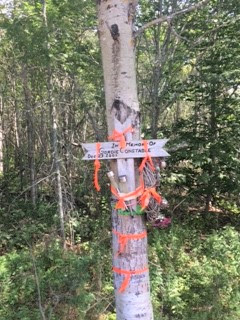
The best berries are clustered around a memorial to Gordie Constable, who died at the site in 2001 as a result of a snow mobile accident.  I met him once - he fixed my car.  I never fail to say hi and thank him for the berries when I pass his memorial.

I braved the thorns and the steep banks to pick about a cup of berries.  They tasted all the sweeter for the effort it took to get them.