Sunday, June 26, 2022

ash tree rust - a mistake

The ash tree in my back yard was growing really well this year, and was over 6 feet tall.  Then within a a week, it was covered with unsightly yellow lesions, and the leaves were curling.


I happened to see a post about the disease online, which led me to believe that the disease is incurable, and will ultimately lead to the death of the tree.  So without doing any other research, I cut down the tree.  Then I looked online, and found this info:  

Although it is unsightly, ash rust is not a serious threat to the tree's health. Because of this, control measures are not usually necessary. Heavy infection may stress a young tree and make it more susceptible to winter injury. Cultural practices that reduce stress, such as watering during dry periods or mulching, can help to improve tree vigor.

The tree had been slowly growing there for about 4 years, but it took just 10 minutes to cut it down.  What a lesson in patience, and in getting all the information before making an irreversible decision.  

Saturday, June 25, 2022

honibe

 honibe, a company that manufactures dried honey products on PEI, offered a giveaway today - two free plants that attract pollinators.  I got there by 8:10 am, and the line up of cars already snaked for about 2 km.   As I inched forward in a line that took 40 minutes, I worried about the air pollution created by all those idling cars as we waited to pick up our free plants that are supposed to help the environment.  


The people directing traffic and handing out plants were cheerful despite the misty rain, and I have to give them credit for their efforts - their hearts are in the right place.


they also gave out samples of honibe products, including gummies.


Here are the two plants I was given - a milkweed and a brown-eyed susan.  I hope to watch them grow and bloom and attract those important pollinating insects!

Monday, January 10, 2022

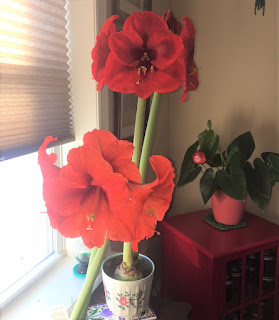
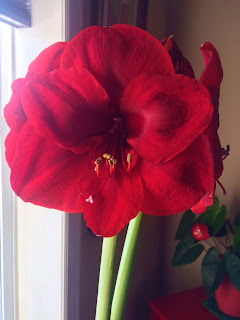
sparkling amaryllis


It is surprisingly hard to take a good picture of my two fabulous amaryllis.  These pics don't do them justice at all.  Bright background light blackens the flowers, and a darker background misses the subtle sparkle of their petals.

The name Amaryllis comes from the Greek word "sparkling".  And that is just what these lovely flowers do in the dead of winter.

Buy Amaryllis bulbs in fall - they are easy to find in grocery and hardware stores.  Most come complete with a compressed package of soil and a decorative pot.  Before you buy, open the box and make sure it has not sprouted a long stem that is crookedly snaking around looking for light.  A bit of green showing at the top is fine.

Put the soil in the pot, add water, and watch it expand.  Plant the bulb, being careful to tuck the roots into the pot, with half the bulb above the surface.  Place in a sunny window, and within about 3 months, the magic begins.


Black Pearl Amaryllis


Red Lion Amaryllis


Growing Amaryllis

  • The soil should drain well.  A mixture containing equal parts of peat and perlite is excellent.
  • Plant amaryllis bulbs in fall.
  • Choose a pot just a bit bigger than the bulb.
  • About one-third of the bulb should be above the soil surface.
  • After planting, thoroughly water the Amaryllis bulb.
  • Place in a sunny window and water when very dry with a balanced fertilizer.
  • Amaryllis bulbs come to flower in about 7-10 weeks.  Turn the pots if the stems lean towards the light.
  • Remove the spent blossoms to prevent seed formation.  After all the flowers are done, cut the stem off just above the top of the bulb.
  • After flowering, the bulb will put out a few long strap-like leaves.  
  • Do not cut off the leaves.  They are making food for the bulb so it can re-bloom next year.
  • When temperatures are reliably over 10 C at night, move the pot to a shady spot outside.
  • Continue to water once a week with weak fertilizer.
  • On September 1, bring the pots into the house. Cut off any dead leaves but do not cut the green ones.  Give them a thorough watering, then put in a dark room at about 55 F (10 C).  Do not water - you are making them go dormant.
  • after 8 weeks (November 1) put in a sunny window, water regularly with weak fertilizer, and the process will start again.

Thursday, October 28, 2021

early October colours


It may be fall, but the perennial plants are not saying goodby just yet. Some of the most vibrant colours are on display right now.  This hardy hibiscus produces massive flowers from big clusters of buds on plants about 3 feet high.  These plants like a sunny spot, a drink of water during dry periods, and your full attention when they are blooming.  As one flower fades, another takes its place.  I leave the tall, tough stalks standing all winter, and cut them to the ground in spring.  They are very slow to get started in the spring, but it's worth the wait.

Staghorn sumac is the first to change colour.

Hardy Geranium (also called cranesbill for the pointy seedpods) started blooming in June, and is still producing new flowers.  


New England Aster grows wild all over the garden.  It has really thrived since I stopped pulling out the seedlings, which I mistook for weeds!  

Bees love these flowers, which provide nectar at a time of the year when most flowers are finished.


Maiden grass has grown from a tiny tuft purchased 5 years ago to a huge clump too solid to separate into smaller pieces.  Ah well, it sure is lovely blowing in the wind all winter.


Monkshood is a tall perennial with deep purple flowers.  They look a bit like pea flowers, with a hood over the top.  Every part of this plant is poisonous, so I don't touch it, but I do enjoy those deep purples.


This rose starts to bloom in yellow, and then gets more spotted and dappled as time goes by.

The plant was purchased as a mini rose in a small pot at a grocery store.  It does not like living in a small pot, and will soon dry out and lose its leaves, but planted it the ground it will be happy for many years.


Rudbeckia (black-eyed susan) blooms from July to October.

It also self-seeds and spreads to unexpected places in my garden.  I assume the seeds stick to my shovel or clothing and drop off and get started without any help from me.  

After the petals fall off, the seeds dry and persist all winter.  They are a great source of food for small birds like chickadees and juncos.

In spring, I cut them all back and wait for the next display!


Below is a colour I definitely do not like.

Mildew has hit this poor bee balm.  I need to cut it low to the ground and dispose of the leaves in the garbage.  The fungus spores are air-borne and can affect other plants too.

Wednesday, October 13, 2021

sour grapes


A grape vine has been climbing up the side of my deck for the past 20 years.  The leaves provide a green haven, a secret spot that I can peek through but can't be seen.  
The grapes (Valient) are just the size of a small blueberry, and each has at least two seeds, but the flavour is really grapey and delicious.  The racoons agree, and help themselves just before I plan to harvest them.  This year I pinned netting over the entire thing, and didn't lose any.
For the past few years, a fungus disease has destroyed the crop before it even formed.  But perhaps because last year was so dry (inhospitable to fungus) there was a bumper crop this year.  
I needed to do something with all this bounty.  I couldn't wait until the grapes were properly ripe because they started dropping, so I went into action.

I picked many buckets of grapes, washed and pulled off all the ripe ones, and set them on the stove with two cups of water.  I let the pot simmer for about 20 minutes, stirring occasionally.

To make jelly, at this point you can put the cooled fruit into a jelly bag and let it drip overnight.
But I find there is quite a bit of waste that way.  I would rather put the whole thing through a food mill.  There will be almost no pulp left behind, and the seeds will be filtered out.

The resulting juice can be made into jelly (it will be more cloudy than if using a jelly bag).  


I also added a bit of white sugar and lemon and froze a lot of the juice.  I make a very satisfying drink with half juice, half lemon-flavoured mineral water.  It's powerful!


Friday, October 1, 2021

putting wild apples to good use

 The wild apple trees in my yard have produced a bumper crop this year.  I am so thrilled by this gift from nature - I need to respect the gift and make something of it.


The apples have never been sprayed, so there are a few blemishes and creepy crawlies, including ants and a slug, but they are easily cut out.

I take out the core, but I don't peel the apples.


It does not take long to make a pot of cut up apples.

I add two cups of water to these 12 cups of apples, and boil gently, stirring occasinally, until very soft - about 20 minutes.


Here is my secret weapon for separating the peels and making great sauce - a very low-tech food mill.  My mom used one just like it 50 years ago.


As the crank turns, the apples are pressed down and through the holes in the strainer, leaving the peels behind.  Then I just add cinnamon and brown sugar and a bit of lemon juice and rind, and I have the best apple sauce ever!  


I added some brown sugar, cinnamon, nutmeg and ginger, and canned a few jars of sauce.  I also froze some.  Now we can have delicious applesauce all winter!


I also made apple jelly for the first time.  I set up a jelly bag, poured the cooked apples into the bag, and let it sit overnight. 

Then I poured the juice into a big pot, added the juice of a lemon and a bag of Jam and Jelly Mix, and boil 4 minutes, take off the heat and stir 5 minutes, and then ladle into canning jars. I bring the lids to a boil, carefully wipe the jar rims, and set the lids on , and add the screw top.  It is important to carefully set the jars down and not disturb them for 24 hours.  The sound of the jars popping, which means they are sealed, is so reassuring!

The pinker colour in the top jar comes from adding a few rose hips to that batch.  


I use Lantic jam and jelly mix, which is a combo of super fine sugar and pectin, and carefully follow the directions.  It works very well with jam, even though I use more fruit than the directions call for.  But jelly is a bit more fussy.  

Unfortunately, my first batch of jelly came out really watery, so I had to dump all the jars and cook it again - and then it turned out too rubbery!  

For my next batch, I cooked the jelly 2 minutes longer than recommended - 6 minutes instead of 4.  It turned out perfect!


Tuesday, May 18, 2021

racoon momma

One night when it was almost dusk, I looked out the deck window to find this little scamp hunkered down in the bird feeder enjoying the sunflower seeds meant for my feathered friends.


When I first went outside, she made her way down the side of the deck, only to change her mind when she realized I wasn't going to yell at her.  I noticed her tummy, and evidence she was suckling babies, and it would be pretty cold to deny a hard-working mom a bit of food.
She went right back up and plopped herself back into the feeder, and chomped away happily.  

I was desperate to give her a scratch between those adorable fuzzy ears, but I was sure she would not approve.  

I received positive feedback from most people who saw the pictures, but I did get one comment that said "appearances can be deceptive and racoons can be quite vicious."  Well, I would be a lot more afraid if a PERSON was hanging out on my deck.  

These photos were taken with my cell phone, and are disappointingly blurry.  I have armed myself with my digital SLR since that night, but unfortunately, she has not posed for me again.  Still hoping for a new photo op.