Thursday, July 6, 2023

bad weed: lily of the valley


Lily of the valley has tremenously beautiful and fragrant flowers that bloom in early June on PEI.  
This perennial is not considered a weed because people plant it on purpose, but it sure is invasive.  
A small patch will soon produce a dense network of roots that spreads throughout the flowerbed and into the lawn, choking out any other plants in its way.  


The roots are deep in the ground and it is very hard to get rid of all of them.  Any bits left behind will re-sprout and carry on as if nothing has happened.  I have been pulling and digging the roots, but there will always be some left behind.

My advice is not to plant them in your garden.  The pretty flowers are not worth the effort of keeping them contained.

Tuesday, July 4, 2023

bad weed: creeping jenny


Many years ago, I purchased creeping jenny to add to my outdoor flower containers.  Creeping jenny is labelled as an annual, and who would not believe a plant tag?  At the end of the season, I dumped the containers into my vegetable beds.  The next spring, I was surprised to find that the creeping jenny that had spent all winter with its roots in the air was still alive.  

Foolishly, I thought this would be a great plant for my garden, so I dug up and planted bits all over.  The plants flourished so well, that they took over the flower beds, filled up every bit of open space, and got into the lawn as well.  They root from every node, which means every inch or so.  They break when you pull them, and every bit of root that stays in the soil will start a new plant.  

It is important to put the pulled plants in a plastic bag and in the garbage, not the compost, where they will happily re-root and continue their thuggish ways.

They are lovely in early summer, with bright yellow-green leaves that contrast with everything else.  But by mid summer they become crispy and ugly, but are still almost impossible to remove completely.  Herbicides don't really work - you need to be careful not to apply so much that you kill the top growth before the chemical reaches the roots.  Nothing but repeated digging gets them.  They can even survive weeks covered with a tarp, getting no light.

I still try to get them out, but they have overtaken a few of my beds, winding around perennials and covering the ground with their leaves.  In one area beside the vegetable beds, I pulled out as many as I could find, and then covered the area with plastic and then pine needles for a year.  The fight continues!

Monday, June 26, 2023

bad weed: small flowered touch me not


In the shady nooks under the trees in my backyard are hundreds and thousands of these plants - called small flowered touch-me-not.

The plants are happily growing right through many inches of pine needles.

Also known as small-flowered jewelweed, is an annual flowering plant originally from Asia. It grows up to 60 cm in height, and has a shallow root system with translucent stems.

It has very small pale yellow flowers.  But they pack quite a punch.  

Touch-me-nots earn their name from ejecting their seeds from their seedpods when ripe. If left to ripen, the seeds explode in all directions, and next year there will be hundreds and thousands, like there are in my back yard.

This plant is typically found in forestlands and forest edges. It invades forest edges, disturbed sites, edges of waterways, and prefers moist soil. Because of its small and inconspicuous form it has gone unnoticed and is much more widespread than thought. Touch-me-nots can quickly disperse across the forest floor. This can effect forest regeneration. It crowds out native species and ultimately reduces biodiversity. 

hundreds of pulled touch-me-nots, with thousands still standing

one of many wheelbarrows full of pulled touch-me-nots


The thin filaments are pods starting to ripen. 
Once they do, the seeds shoot out after the least disturbance.

Controlling this thug

  • the good news:  since these plants have shallow root systems, they are fairly easy to hand pull. Pull when soil is damp so roots will be removed as well. 
  • Avoid disturbing the plants when the seeds are ripe. Any disruptions may cause seeds to shoot out further around the site. 
  • Do not compost; dispose the plant properly at the landfill.  Well, I don't have that option - I'm piling them in a spot in the back with their roots up in the air.  Hope they don't reproduce from there.
  • these weeds can grow right through hosta


plants and flowers of Croatia


When my husband Wayne suggested we visit Croatia, I was not particularly impressed or interested.  I  knew nothing about the country located along the coast across the Adriatic Sea from Italy.  

Turns out, the country is a stunning mix of limestone cliffs plunging into blue-green waters, mountains,  rocks, and lush plants.  The coastline regularly sees winds over 200 kilometres per hour, but there is none of the downed trees and missing roofs that plagued Prince Edward Island after sub-tropical storm Fiona blew through at windspeeds of over 130 km last September.  The Croatian buildings are built to withstand those winds - built with stone and tile roofs that don't blow off.  Now, I am impressed.

Here is a list of some of the cool plants I found:

huge palm trees in Split
Huge palm trees in Split - the climate in the south is Mediterranian, with palms, tall thin cypress trees, lavender, and figs.


The palm trees big and small support their own ecosystems, with tiny plans growing in the cracks between the bark.


Another big palm 


Cupressus sempervirens, the Mediterranean or Italian cypress, is a native conifer of the Eastern Mediterranean, the cradle of Western civilization. It grows 20 to 30 feet tall, with aromatic wood and scaled leaves. Cypresses are long-lived trees.

The Italian cypress is hardy from USDA zone 7 to 9.  PEI is not the place for this tree.

Look closely at the trunk and you will see me.


above - baby figs can be seen growing close to the stem.

left - fig seedlings are everywhere - this one was growing in Krkr national park.


Oleander grows everywhere in colours of white, pale pink, and red.  Cultivated on lawns, and growing wild along roadsides, the profusion of flowers is stunning.  Unfortunately, no scent though.


The tiniest flower I found growing on a mossy rock in Rastoke amid rushing waterfalls.


Agave plants in Zadar.  These also grow everywhere.


On the road from Dubrovnik, from a high point, we could see valleys cultivated with fruit trees and vegetables, striped with irigation canals.


A type of snap dragon finds a foothold in cracks of an old limestone wall in Split.  Life is everywhere, even in the most inhospitable places!


Huge old London Plane trees in Zagreb and throughout Croatia.  I love the patterns of the bark.


Fragrant rosemary grows 3-4 feet high.

No fear of the cold here.


Thick ropes of ivy climbs a tree, using small supports to hang on to the trunk.


We didn't get to the botanical garden in Zagreb - it closed at 1:30 (??) but this is a view of the flowers in a local park.


huge bunch of Russian Sage


Passionflower vine.  Those who named this plant saw great symbolism in this flower, seeing a representation of the passion of Christ at the crucifiction.  The three parts of the style represent the three nails that attached Jesus to the cross.  The 5 anthers represent his 5 wounds.  The many filaments are the crown of thorns.  And the 10 petals are the 10 loyal apostles.

not a plant - but this was the coolest thing.  Half-way up a church tower in Cortula, at about 50 metres high, a mama seagull and her two babies hung out on a narrow ledge.  Made me dizzy to think about it, but it is a spot safe from preditors, although not safe from a long fall. 

Sunday, June 26, 2022

ash tree rust - a mistake

The ash tree in my back yard was growing really well this year, and was over 6 feet tall.  Then within a a week, it was covered with unsightly yellow lesions, and the leaves were curling.


I happened to see a post about the disease online, which led me to believe that the disease is incurable, and will ultimately lead to the death of the tree.  So without doing any other research, I cut down the tree.  Then I looked online, and found this info:  

Although it is unsightly, ash rust is not a serious threat to the tree's health. Because of this, control measures are not usually necessary. Heavy infection may stress a young tree and make it more susceptible to winter injury. Cultural practices that reduce stress, such as watering during dry periods or mulching, can help to improve tree vigor.

The tree had been slowly growing there for about 4 years, but it took just 10 minutes to cut it down.  What a lesson in patience, and in getting all the information before making an irreversible decision.  

Saturday, June 25, 2022

honibe

 honibe, a company that manufactures dried honey products on PEI, offered a giveaway today - two free plants that attract pollinators.  I got there by 8:10 am, and the line up of cars already snaked for about 2 km.   As I inched forward in a line that took 40 minutes, I worried about the air pollution created by all those idling cars as we waited to pick up our free plants that are supposed to help the environment.  


The people directing traffic and handing out plants were cheerful despite the misty rain, and I have to give them credit for their efforts - their hearts are in the right place.


they also gave out samples of honibe products, including gummies.


Here are the two plants I was given - a milkweed and a brown-eyed susan.  I hope to watch them grow and bloom and attract those important pollinating insects!

Monday, January 10, 2022

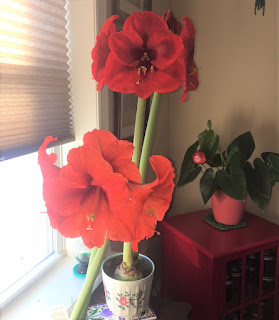
sparkling amaryllis


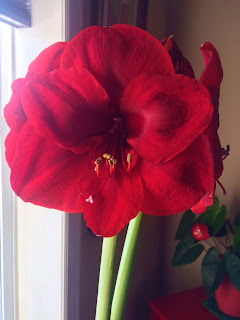
It is surprisingly hard to take a good picture of my two fabulous amaryllis.  These pics don't do them justice at all.  Bright background light blackens the flowers, and a darker background misses the subtle sparkle of their petals.

The name Amaryllis comes from the Greek word "sparkling".  And that is just what these lovely flowers do in the dead of winter.

Buy Amaryllis bulbs in fall - they are easy to find in grocery and hardware stores.  Most come complete with a compressed package of soil and a decorative pot.  Before you buy, open the box and make sure it has not sprouted a long stem that is crookedly snaking around looking for light.  A bit of green showing at the top is fine.

Put the soil in the pot, add water, and watch it expand.  Plant the bulb, being careful to tuck the roots into the pot, with half the bulb above the surface.  Place in a sunny window, and within about 3 months, the magic begins.


Black Pearl Amaryllis


Red Lion Amaryllis


Growing Amaryllis

  • The soil should drain well.  A mixture containing equal parts of peat and perlite is excellent.
  • Plant amaryllis bulbs in fall.
  • Choose a pot just a bit bigger than the bulb.
  • About one-third of the bulb should be above the soil surface.
  • After planting, thoroughly water the Amaryllis bulb.
  • Place in a sunny window and water when very dry with a balanced fertilizer.
  • Amaryllis bulbs come to flower in about 7-10 weeks.  Turn the pots if the stems lean towards the light.
  • Remove the spent blossoms to prevent seed formation.  After all the flowers are done, cut the stem off just above the top of the bulb.
  • After flowering, the bulb will put out a few long strap-like leaves.  
  • Do not cut off the leaves.  They are making food for the bulb so it can re-bloom next year.
  • When temperatures are reliably over 10 C at night, move the pot to a shady spot outside.
  • Continue to water once a week with weak fertilizer.
  • On September 1, bring the pots into the house. Cut off any dead leaves but do not cut the green ones.  Give them a thorough watering, then put in a dark room at about 55 F (10 C).  Do not water - you are making them go dormant.
  • after 8 weeks (November 1) put in a sunny window, water regularly with weak fertilizer, and the process will start again.