Sunday, November 8, 2015

a walk on the Boughton River trail

Saturday was another beautiful fall day. It was windy, but at 12 degrees, we had to get out there and take another walk.

At the eastern end of PEI, the Boughton River trail starts at Bridgetown, about 65 km east of Charlottetown.  The start of the trail is on Highway 4, on the right, just past the firehall in Bridgetown.

The trail follows the Boughten river on both sides.  It is narrow, with lots of ups and downs, exposed roots, and foot bridges.


It is rare to see any wildlife when we travel in a big group, but today we it was just the two of us, and we got really lucky.  I thought I was walking past just one more stick, but Wayne suddenly yelled "don't step on that snake!"  And there it was, about 14 inches long, grey and black, with a long red tongue tipped in black.  It acted like a much bigger snake with a feisty, aggressive attitude - it coiled up and struck at us.  I think it's an Eastern Garter Snake.  I'm glad I'm not a mouse!
.


Lots of foot bridges are kindly covered with old shingles to prevent us old walkers from slipping.

My theory as to why tiny trees in the woods have really big leaves:  The trees in the woods are fighting for the light.  Small trees are shaded out by big trees.  The small trees produce big leaves as a way to catch as much light as possible, which they turn into energy so that they can grow tall too.

big beech leaves on a tiny tree

Larch can't really be called an evergreen:  it produces needles but drops them in the fall.

This hen of the woods fungus is growing around a wild rose.  This mushroom is often found at the base of oak trees.  It has many overlapping brown-colored spoon-shaped caps. The interior flesh is white, and the bottoms of the caps are covered with tiny pores instead of gills. The caps grow on short stems and each stem originates from one common, heavy stalk. Although some hens-of-the-woods appear to be attached to the lower trunk of a tree, they actually sprout from the trees’ root system.  This is an edible mushroom that can be sauteed in butter.

Mountain ash berries drop from neighbouring trees.

this stump is starting to decay in a rounded pattern.

Walking along the trail seems like you are in the middle of the wilderness, but the sounds of civilization are always present.  Looking through the trees to the other side of the river, and there are signs of people everywhere.

a walk at Brookvale

Brookvale isn't just a ski park.  Past the alpine ski park signs is the other Brookvale - this is for cross-country skiiers in the winter, and for walkers the rest of the year.
To get there from Charlottetown, take the Transcanada west to Cornwall.  Turn right at highway 248 and then left at #235, Kingston Road.  Drive about 16 km, turn left on #13, and it's on the left.

The beeches are a vivid yellow, the weather is warm, and there is no better place to be than walking in the woods.

Many trails criss-cross through the park, and you could be there a while if you get confused.

This steep hill would be quite a chore to ski up in the winter.
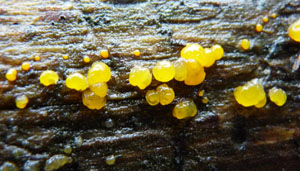
Witch's butter is a bright yellow jelly fungus. It develops on dead pine trees whose bark has fallen away.  It typically appears after a heavy rain fall.  Although it is flavourless, it is reported to be edible only when cooked, and can be used as a thickener in soups.

According to legend, if witch's butter appears on the gate or door of your home, you have been targeted by the spell of a witch.  The remedy is to pierce the jelly with something sharp until it dies.


These mushrooms look like they were spilled out of a basket.

Tiny mushrooms poke out of a carpet of low-growing plants.

The trail snakes and doubles up onto itself as it winds through the trees.
The frost has reddened these blackberry leaves.

old man's beard

Wednesday, October 28, 2015

a walk in Breadalbane


From a plaque near this site:

Breadalbane was a bustling community on the upper Dunk River in the 1870s with several businesses. 
James Holmes had built adjacent saw and shingle mills. He was also the first postmaster for a year and the office was first named Holmes Mills PO even though the community became Breadalbane. 
In 1917 the mill site was acquired by Pomroy Murray who added a small two-storey electric light plant. 
The system produced enough power for distribution through the community but only for a few hours in the evenings. However, special provision was made for the hours of 10 am to noon on washdays.

First of all - try to pronounce it:  me and my Ontario ways had a hard time with this one:
bread - all - bun.
Beautiful downtown Breadalbane has a really nice park with a playground equipment, gazebo, even a washroom.  Other tiny towns take note!

To get there from Charlottetown, take highway 2 east, past Hunter River, Fredericton and Pleasant Valley. Turn left on Route 231 at the bottom of a hill.  There doesn't seem to be a sign for 231, so watch for an abandoned garage on the left just before the turn.

Drive 2 km to the village, turn left and park along the park.  Continue down the road, and the beginning of the trail is on the left, just after a babbling Dunk River.

This walk is probably my favourite so far.  It's a very narrow path, crossed with roots, along a steep bank with the river meandering below.


The beginning of the trail.

A Norway maple with tar spot, a fungus disease.  This maple is not native to PEI.  
The native maples do not get this disease.  
I have cut down all the Norway maples on my property just for this reason.


This is a burl - quite a common sight in PEI forests.  
It's like cancer in trees - cells in a certain spot begin to multiply out of control.
Apparently, little research has been done on the cause of this disease, but it is speculated that burls could be caused by a virus or insects.  But it's not all bad.  The wood from a burl is very beautiful and very hard.  Burls have been made into bowls and other decorative objects.
.
It's a narrow, root-lined path with a steep drop-off down a bank into the Dunk River.


confluence of three streams

raspberry leaves are touched with frost.

foam in the water - I never know if foam is caused by pollution or if it is a natural occurance


This tree is slowly being eaten from the inside out by fungus.
The outline of the trail follows both sides of the Dunk River.


We had the choice of continuing the hike or crossing this bridge - only four at a time because it's a bit rickety.  We were told that the steel girders holding up the bridge were air-lifted in by helilcopter.  There really would be no other way to get them here on these narrow goat paths.


 misty pastel colours from a touch of frost.


This hiking group has been incredibly lucky with the weather.  Every Wednesday morning we have gone hiking has been gloriously sunny.

Sunday, October 25, 2015

a walk at Strathgartney Park

Take the trans canada highway towards the bridge.  turn left at the sign for Strathgartney, and you will walk one of the most challenging trails on PEI - lots of steep hills, and roots to trip you.  But it's worth the walk.


the beginning of the trail

down the hill and through the gate

This white spruce looks like it sprouted red leaves.


this hollow tree is big enough to get inside

a group of blackened mushrooms at the end of their lives


spectacular view from the parking lot

a walk on McKenna scenic heritage road

The guide book says this is the prettiest hike on PEI, and it may be right.
It's about 30 km from Charlottetown.  Take the TransCanada, turn right in Cornwall at #248, then the next left #235/Kingston Road.  drive 16 km and turn left on highway 13.  After 5 km, turn left on #246/South Melville Rd. and drive 1.5 km.  McKenna Road is on the left.  It's a red clay road that meanders for about 9 km.  The only down side is that it's not a loop, so you need to make a decision about when to turn back and walk the same distance back to the car.

The forest is sugar maples, spruce, birch, and these lovely yellow beech.

The sides of the road are bordered by embankments covered with lichen and moss.


A hole in the bank covered with lichen looks like a cave.

red maple leaf on a white spruce bow.

fungus on the side of a big tree.


this mushroom is growing horizontally out of a bed of moss on the embankment.

a peeling birch


the bad side of the trail  - how can people dump a mattress in such a beautiful spot?