Check out his video here: https://www.youtube.com/watch?
Friday, February 22, 2019
skate boarding
This post has nothing to do with a garden, and nothing to do with me. Our son Dylan the world traveller made a video of himself and his friends skate boarding in Seoul, Cambodia, and Taiwan. He is back in Canada now, and finding it hard to get his wheels to turn in all that snow.
Check out his video here: https://www.youtube.com/watch?
Check out his video here: https://www.youtube.com/watch?

skating on thin ice
This has been an unusually severe winter. Lots of snow, followed by one-day thaws, followed by -15C, followed by rain. It has made the place a skating rink. Literally in the fields behind my house.

 The weather has put a monkey wrench in my cross-country skiing. It is so slippery under the coating of powdery snow, I'm afraid to get out there. And there are huge areas I can't cross.

So let's make lemonade out of this lemon. Our son Dylan took my negativity and decided it would be perfect skating rink. He took out a camp chair to put on his skates, and away he went, exploring the field on his blades.


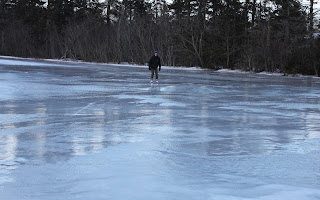
 One great thing about this natural rink is that it is directly on the ground - no danger of breaking though and falling into cold water, because the ice is only a few cm thick.

 The weather has put a monkey wrench in my cross-country skiing. It is so slippery under the coating of powdery snow, I'm afraid to get out there. And there are huge areas I can't cross.
So let's make lemonade out of this lemon. Our son Dylan took my negativity and decided it would be perfect skating rink. He took out a camp chair to put on his skates, and away he went, exploring the field on his blades.


Tuesday, February 12, 2019
winter sowing
I have never had luck growing perennial flowers from seeds indoors. The few seeds that do sprout are leggy and weak. It's too warm on the window sill.
There is a new way to get new plants from seeds without using up precious inside space: winter sowing. We will let Mother Nature provide the light and the water and the space.
 First, get some plastic jugs. Drill holes in the bottom and along the sides.
With an x-acto knife, cut horizontally around the container about 1/3 from the bottom, leaving a few inches uncut on one side to act as a hinge. Take off the screw tops so that rain can get in.

Grab some good quality potting soil. It is much lighter and the little seedlings will be able to push their roots through much more easily than if you use garden soil. Plus, garden soil is frozen hard as concrete in my yard right now! Add water until it is quite wet.
Put at least 4 inches of soil in each jug, and pack down firmly.
 Choose seeds from plants that grow well in your area and self-seed. I have chosen coriander, wild bergamont (bee balm), and columbine. I am starting slow, but some people I know have started 90 jugs or more!
 Here are some coriander seeds, ready to be planted. After setting in the seeds, cover with a thin layer of soil and pat down firmly. Use a sharpie to write the name of the seed on a plastic label, and push it inside between the soil and the plastic. That way you can easily read the label. Then close the tops over the bottoms and tape the openings shut.

Bring your containers outside and set them in a sunny spot. Mine are in the raised vegetable garden bed. I put a log against the open side to make sure they don't blow over in the wind. Now ignore them until spring. The freezing and thawing cycles will get the seeds ready to pop in spring, and the jugs will act as mini greenhouses to give them a head start.
Stay tuned to see what happens!

Fast forward to the middle of June. I checked the containers often, but the seeds took a very long time to sprout.
 The monarda (bee balm - left) and cilantro did really well. Only one columbine appeared.
I transplanted everything to permanent homes, and they are doing well.
I would definately try this again next February!
There is a new way to get new plants from seeds without using up precious inside space: winter sowing. We will let Mother Nature provide the light and the water and the space.

With an x-acto knife, cut horizontally around the container about 1/3 from the bottom, leaving a few inches uncut on one side to act as a hinge. Take off the screw tops so that rain can get in.

Grab some good quality potting soil. It is much lighter and the little seedlings will be able to push their roots through much more easily than if you use garden soil. Plus, garden soil is frozen hard as concrete in my yard right now! Add water until it is quite wet.
Put at least 4 inches of soil in each jug, and pack down firmly.


Bring your containers outside and set them in a sunny spot. Mine are in the raised vegetable garden bed. I put a log against the open side to make sure they don't blow over in the wind. Now ignore them until spring. The freezing and thawing cycles will get the seeds ready to pop in spring, and the jugs will act as mini greenhouses to give them a head start.
Stay tuned to see what happens!

Fast forward to the middle of June. I checked the containers often, but the seeds took a very long time to sprout.

I transplanted everything to permanent homes, and they are doing well.
I would definately try this again next February!
flowers inside
It is -10 celcius and the wind is roaring, but inside, things are blooming!

The amaryllis took a long time to get started this year - I bought the bulbs in November, and no life appeared until January - but they are making up for lost time.

Two weeks ago, I cut some branches from my forsythia shrub and brought them inside, plunked them into water, and now there is a bit of spring come early in my house!
 This orchid has been persuaded to reflower many times. My secret is to whip up a batch of lukewarm water, use half as much orchid fertiliser as recommended, fill the entire container with the water and let sit for a half hour. Then drain the water completely, and use it for other plants. Do this once a week, and it will probably work for you too!
 I just brought home this miniature rose, and it looks lovely on the windowsill with snow behind it. When it stops blooming in a few weeks, I will water it sparingly, let it rest, and then in June I will cut it back and plant it outside in a sunny spot. These roses are perfectly hardy and will survive PEI's cold winters year after year.
 The dainty pale pink flowers of this burgundy shamrock (oxalis) make a great contrast with the leaves.
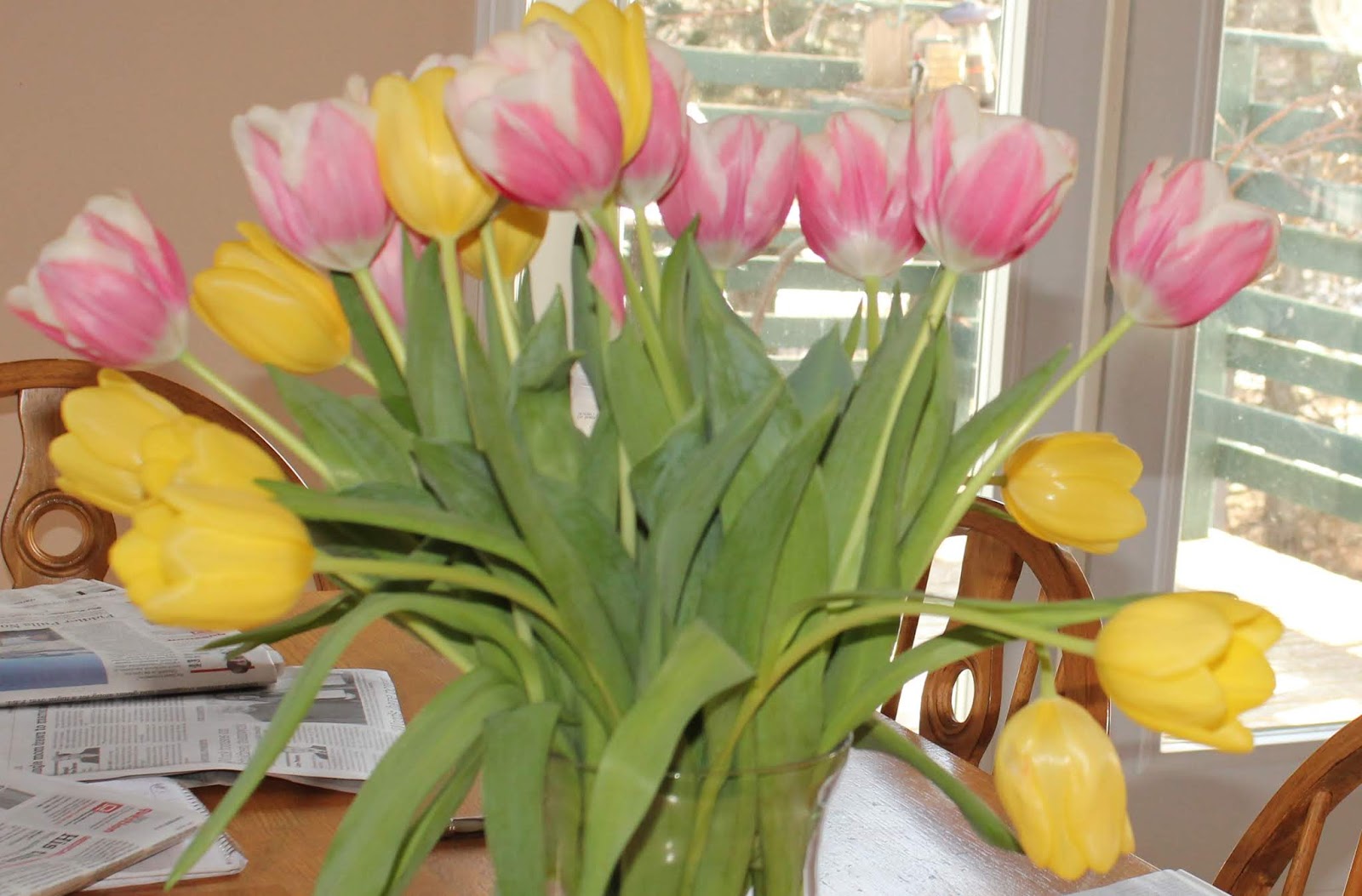
 Here are some tulips I bought for my birthday. It will be 3 months before the outside ones open their petals.

When I was rumaging out in the garage, I was horrified to find this pot of hyacinths I had foolishly left there for almost a year. I had purchased these forced bulbs last year, and I should have planted them outside in the spring. Against all odds, green growth showed between the cracks of dessicated soil that had not been watered for all that time. I brought the pot into the house, and within a week the darlings bloomed and rewarded my negligence with their lovely scent. Nature truly is persistent!

The amaryllis took a long time to get started this year - I bought the bulbs in November, and no life appeared until January - but they are making up for lost time.

Two weeks ago, I cut some branches from my forsythia shrub and brought them inside, plunked them into water, and now there is a bit of spring come early in my house!



When I was rumaging out in the garage, I was horrified to find this pot of hyacinths I had foolishly left there for almost a year. I had purchased these forced bulbs last year, and I should have planted them outside in the spring. Against all odds, green growth showed between the cracks of dessicated soil that had not been watered for all that time. I brought the pot into the house, and within a week the darlings bloomed and rewarded my negligence with their lovely scent. Nature truly is persistent!
Monday, December 17, 2018
a bird in the garage is worth a look
Back in October, I accidently left the side garage door open when I grabbed some gardening stuff.
When I came back in, I heard some loud rustling and squeaking. Struggling to get out a window it didn't understand was this lovely bird.


I couldn't figure out how to get the bird out of the garage. I thought about throwing a blanket over it, but I didn't like the looks of its claws and beak. When my husband Wayne came home, he came up with the obvious: just open the big front garage door. He went around to the outside of the window, gave a little tap on the glass, and the bird finally got the idea. It swooped out the door and into the blue sky. What a treat to see this magnificant bird up close, and I'm so glad all ended happily.
The visitor was a ruffed grouse. I have never seen one before. Here are some facts about ruffed grouse from http://www.ruffedgrousesociety.org/grouse-facts
When I came back in, I heard some loud rustling and squeaking. Struggling to get out a window it didn't understand was this lovely bird.


I couldn't figure out how to get the bird out of the garage. I thought about throwing a blanket over it, but I didn't like the looks of its claws and beak. When my husband Wayne came home, he came up with the obvious: just open the big front garage door. He went around to the outside of the window, gave a little tap on the glass, and the bird finally got the idea. It swooped out the door and into the blue sky. What a treat to see this magnificant bird up close, and I'm so glad all ended happily.
The visitor was a ruffed grouse. I have never seen one before. Here are some facts about ruffed grouse from http://www.ruffedgrousesociety.org/grouse-facts
- adults are about 40 cm long and weigh 500 g
- less than half make it to one year, and their lifespan is 2-3 years
- live primarily on the ground, but are strong short-distance fliers
- eat the buds and leaves of poplars, birch, and alders
- live in areas recently clear-cut. Old growth forests do not provide food
- foxes, coyotes, hawks and owl eat them
- males are territorial and make a drumming sound to attract a mate
- males do not help raise chicks
Tuesday, October 30, 2018
robin in the fall

American Robins eat invertebrates and fruit. In spring and summer they eat earthworms, insects and snails. They also like chokecherries, hawthorn, dogwood, sumac, and juniper berries. For a list of food suggestions to attract robins and other birds, visit https://feederwatch.org/
Most robins move south in winter. However, some stick around in their summer locations. They migrate more in response to food, or lack of food, than to changes in temperature. Fruit is their main winter food source.

Thursday, October 18, 2018
mystery plant

This guy magically appeared in my back yard, right against the foundation.
It's huge - almost 3 feet across.
I have never seen anything like it.
I have posted it on facebook and asked the Garden Club, but no answers.
The leaves are rough, scratchy, dull, and smell bad when you pick one.

Here is one leaf, almost 20 inches long!
I plan to wait till next spring, when I hope it will bloom, which will make identification easier.

Now it's July 2019, and the plant has taken off. The leaves seem more pointy, and they are smaller than last year, but the whole plant is about 3 feet tall, with purple stems.
I need to wait for the flowers to open, which I hope will make it easier to identify.
I went away for 2 weeks, and when I got back, the plant was just a brown twisted stem on the ground. I never did get to see the open flowers, and I am still in the dark as to what it was. One thing it is not: invasive.
Subscribe to:
Posts (Atom)